| 10-E) So & Neither: agreement (Learn English with Valen) |
 |
UNIT 10 lesson E |
Click on a word and I’ll read it
Or select some text and then click on play.

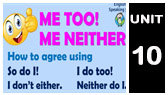
Here you will learn to agree. Read the explanations and then watch this video and the others.
POSITIVE AGREEMENT
To express positive agreement we use: SO + Auxiliary* + Subject
If there is no auxiliary in the sentence, we use DO:
- I live in London and so does Susan = I live in London & Susan lives in London.
Tom: I like pizza
Sean: So do I
= Tom likes pizza and Sean likes pizza too
* special verbs that never use DO (auxiliaries and modals): to be, have, can, could, will, would, shall, should, may, might. These verbs are repeated in the second part of this construction:
- I can speak French
- So can my sister
(= I can speak French and your sister can speak French)
- Peter will go to London for the weekend and so will his sister = Peter will go to London & his sister will go to London
- I'm going to stay here and so are you = I'm going to stay here & you are going to stay here
Colloquial  We can use SUBJECT + TOO for all the sentences.
- I like pizza
- Me too
- I can speak French
- My sister too
- Peter will go to London for the weekend and his sister too
- I can speak French and you too
NEGATIVE AGREEMENT
To express negative agreement we use: NEITHER + Auxiliary + Subject
The word NEITHER can be pronounced N + I + THER or N + EE + THER. In BrE they use the first form, with a diphthong, but some people use the second form. In AmE everybody uses the second form.
NEITHER is a negative word so it is used with an affirmative verb form (we can't have a double negative in a sentence).
I don't live in Rome and neither does Susan = I don't live in Rome & Susan doesn't live in Rome.
Tom: I don't like pizza
Sean: Neither do I
= Tom doesn't like pizza and Sean doesn't like pizza
- I can't speak French
- Neither can my sister
= I can't speak French and your sister can't speak French
- Peter won't go to London for the weekend and neither will you
- I'm not going to stay here and neither are you
Colloquial Me neither (we can only use it with the subject "Me", but not with other subjects)
- I don't like pizza
- Me neither
- I can't speak French
- Neither can my sister (you can't say: My sister neither)

 A quiz to practise SO and NEITHER


More videos from this lesson