| 7-B) Simple present (LiveOnlineEnglish) |
 |
UNIT 7 lesson B |
Click on a word and I’ll read it
Or select some text and then click on play.
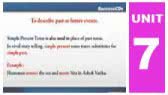
You know the simple present, we have studied the form, the negative and interrogative (see: use of DO) and the use of the simple present (or present simple) tense to talk about habits (see: daily routine and frequency adverbs).
Now we're going to revise it all. Watch this video and read the explanations.
SIMPLE PRESENT TENSE
FORM
We add -S to the 3rd person singular:
I learn English
You learn English
He/She/It learns English
We learn English
You learn English
They learn English
To add this -S we follow the same rules as with the -S for the plural:
If the verb ends in -Y we change -Y to -IES:
- I study, he studies
Except when -Y goes after a vowel:
- I buy bread, he buys bread
If the verb ends in -S or a similar sound, we add -ES and pronounce "iz":
- I pass, he passes
- I fax a document, he faxes a document
- I wish, he wishes
- I watch, he watches
Exceptions:
go -- goes
do -- does
For negatives, we use DON'T
- you speak English / you don't speak English
but we use DOESN'T for the 3rd person singular
- I don't speak English / he doesn't speak English
For questions we use DO
- I speak English / do you speak English?
but we use DOES for the 3rd person singular
- does he speak English? (notice that now the -S is in DOES, not in the verb SPEAK)
Special verbs never change, they don't take an -S and they don't use DO:
- I can speak English / He can speak English
- I study English / I don't study English / Do you study English?
- We are Spanish / We are not Spanish (we aren't Spanish) / Are you Spanish?
- I can speak English / I can't speak English / Can you speak English?
Special verbs: to be, have, can, do, will, would, shall, should, may, might, must, ought to
Normal verbs: all the rest
Note: there is also "to have" and "to do" (normal verbs):
- I don't speak English (special verb)
- I do my homework (normal verb)
- I don't do my homework (special verb + normal verb)
- I haven't got a car (special verb)
- I don't have a car (normal verb)
USE
We use the simple present tense to talk about habits:
- I get up at 9 o'clock
- She goes to School every day
We use the simple present tense to talk about things that are always true:
- The sun goes up in the morning
- Lions live in the jungle
We can use the simple present tense to talk about the future (we will study this in unit 9):
- The train to London leaves at 9:00


More videos from this lesson