Multimedia-English: Learn Real English, Prepare for Real Life
Home About Contact Phonetics Links Info Facebook Users Open Section Home
Advanced
HOME » BEGINNERS » Basic Real English » Unit 8 » Lesson H
« Back
 
Rating: *****   Add to Favourites          Share Easy reader:    PRINT: Print       
8-H) Comparison of adjectives    Time: 2:23    Accent: e Korean Dictionary    Sound BrE    Explanations

8-H) Comparison of adjectives


More suggestions
  • Description
  • ES Español
  • +More

Description

Here we will learn about the comparison of adjectives.

Read the explanations and then watch the videos.

Español

Vamos ahora a aprender cómo hacer comparaciones con adjetivos. Lee primero las explicaciones y luego mira los vídeos.


Imprimir: Imprimir datos
 

Links

CLICK
AmE 1- Comparatives: 2 video lessons and explanations


CLICK
BrE 2- Listen to this song by Jesse McCartney and see if you can hear when he says "What's your name?"


  • Explanations
  • Error Report mistakes

Explanations

SIMILARITY AND IDENTITY (=)

If two things have the same quality we can use AS... AS
- My hands were as cold as ice --> my hands were very cold and ice is very cold
- John is as tall as me --> I am 1.89 ms tall and John is 1.89 ms tall
negative: NOT SO/AS... AS
- Peter is not so old as Sarah
- This park is not as beautiful as the park near my house

INFERIORITY (<)

To express inferiority we use LESS
- Jimmy is less tall than Paul --> Jimmy is 1.69 ms and Paul is 1.72
- Your books are less heavy than mine

SUPERIORITY (>)

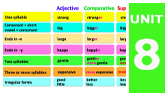
To express superiority we have two different forms, depending on how many syllables the adjective has.

Short adjectives (1 syllable)
We add -ER to the adjective and then we use the conjunction THAN.
tall --> taller
nice --> nicer
old --> older
- Paul is taller than Jimmy --> Paul is 1.72 and Jimmy is 1.69
- I like Susan, but Mary is nicer (Mary is nicer than Susan)
- My father is 25 years older than me

 Long adjectives (3 or more syllables)
We put MORE before the adjective and THAN after the adjective.
- Paul is more intelligent than Jimmy
- This film is more interesting than the one we saw yesterday

2-syllable adjectives
If they end in -Y they take the ending -ER.
happy --> happier
easy --> easier
If they don't end in -Y they usually use MORE.
- Tom is more polite now than he used to be
- Hats were more common in the past
But some of them can take -ER or both constructions.

SPELLING

If the adjective ends in -E they just add the -R.
nice --> nicer
late --> later
If the adjective ends in one single vowel + one single consonant, it doubles the final consonant.
fat --> fatter
big --> bigger
thin --> thinner

IRREGULAR ADJECTIVES

These three adjectives have irregular forms for the comparative:
good - better
bad - worse
far - farther

Now you can practise here: Comparatives Exercise. (here you have exercises about the comparative and the superlative, so if you don't know the superlative you can't get some of them right).

INTENSIFIERS (>>)

If we want to express that the two things that we compare are very different we can use MUCH or FAR before the comparison.
- Mark is much taller than Nick --> Mark is 1.86 and Nick is 1.55 ms
- Your house is far more beautiful than mine
In colloquial English we can also use WAY
- A car is way heavier than a bicycle   (heavy --> heavier)
We can intensify it even more by saying:
- He's much much older than me

Please log in to enter a dedication or register as a user.

Please log in to do a report or register as a user.

Post your comment: click here to write.

 
  • Users
  • Teachers can enter suggestions for class exploitation