Multimedia-English: Learn Real English, Prepare for Real Life
Home About Contact Phonetics Links Info Facebook Users Open Section Home
Advanced
Please, donate.
HOME » BEGINNERS » Basic Real English » Unit 8 » Lesson I
« Back
 
Rating: *****   Add to Favourites          Share Easy reader:    PRINT: Print       
8-I) Superlatives    Time: 1:20    Accent: r New Zealand Dictionary    Sound BrE    Explanations

8-I) Superlatives


More suggestions
Tags:
  • Description
  • ES Español
  • +More

Description

Here we will learn about the superlative form of adjectives.

Read the explanations and then watch the videos.

Español

Lo que los ingleses llaman "superlativo" es simplemente una forma comparativa en la que se compara una cosa con un grupo:

comparative --> Peter is taller than John = Pedro es más alto que John
superlative --> Peter is the tallest in his family = Pedro es el más alto de su familia.

Lo que en español llamamos superlativo se construye en inglés con SO:

Oscar es altísimo = Oscar is so tall
Tienes un coche grandísimo = You have a car so big
tu coche es grandísimo = Your car is so big.

Si ya te sabes bien el comparativo de superioridad de los adjetivos, el superlativo es bien fácil. Lee las explicaciones.


Imprimir: Imprimir datos
 

Links


CLICK
AmE 1- Comparatives & Superlatives: Sesame Street


CLICK
AmE 2- Comparatives & Superlatives: Street interviews


CLICK
NoVoice 3- Comparatives & Superlatives: Exercises


Pronunciation course now 67% off the price for users of Multimedia-English!

  • Explanations
  • Error Report mistakes

Explanations

The comparative form of the adjectives is comparing two things. The superlative is comparing more than two things:

comparative --> Peter is taller than Mike
superlative --> Peter is the tallest in his family   (he is taller than his father, taller than his mother and taller than his sister)

If you know the comparative of superiority, the superlative is very simple, almost the same.

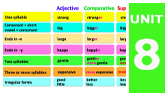
To make the superlative we have two different forms, depending on how many syllables the adjective has.

Short adjectives (1 syllable)
We add -EST to the adjective and use the article THE.
tall --> the tallest.
nice --> the nicest.
old --> the oldest.
- Paul is the tallest in his family --> Paul is 1.72, his father is 1.70, his mother is 1.69 and his sister is 1.54
- I like Susan and I like Tally, but Mary is the nicest --> Mary is nicer than Susan and Tally
- My grandfather is the oldest man in the village --> nobody is older than my grandfater.

Long adjectives (3 or more syllables)
We put THE MOST before the adjective
- Paul is the most intelligent student in class
- This film is the most interesting film of 2009

2-syllable adjectives
If they end in -Y they take the ending -IEST.
happy --> the happiest
easy--> the easiest
If they don't end in -Y they usually use THE MOST
- Tom is the most polite.
But some of them can take -IEST or both constructions.

SECOND TERM OF COMPARISON

When we compare one thing with a group, the group is introduced by IN (sometimes by OF)

- Tom is the youngest person in his family
- This is the most beautiful flower in the garden
- This is the most important festival of the year

SPELLING

If the adjective ends in -E they just add the -ST.
nice --> the nicest
late --> the latest
If the adjective ends in one single vowel + one single consonant, it doubles the final consonant.
fat --> the fattest
big --> the biggest
thin --> the thinnest

IRREGULAR ADJECTIVES

These three adjectives have irregular forms for the comparative:
good - better - the best
bad - worse - the worst
far - farther - the farthest

INTENSIFIERS (>>)

If we want to express that the three or more things that we compare are very different we can use BY FAR before the comparison.
- Mark is by far the tallest of all --> Mark is very tall and nobody is taller than him
- Your house is by far the most beautiful house in the village

You can dedicate this video to a person and write a message for them here. Your dedication will be visible for one month.

Error Report problems or mistakes


Send

Post your comment: click here to write.

 
  • Users
  • Teachers can enter suggestions for class exploitation