| On the phone (ABA English) |
 |
PRACTICE 3 - part of lesson L |
Click on a word and I’ll read it
Or select some text and then click on play.
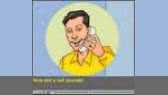
Learn about the phone and telephone conversations. Listen to this example conversation here.
[ring ring]
- 877 94 00. San Francisco General Hospital.
- Mrs Chairnaugh's room, please.
- Mrs Chairnaugh's?
- Yes. C-H-A-I-R-N-A-U-G-H.
- Room 1425. Hold on.
...
- Hello? Mr. Chairnaugh speaking.
- Hi, Peter. This is Carol. How are you?
- It's a girl! 9.5 pounds! She's OK and we're very happy.
- Oh Peter, congratulations! I am so happy too! Is Susan there?
- Yes, of course. Hold on. (Susan, it's Carol)
- Hello, Carol. I'm the mother of a very pretty girl. She's a real sweetie.
- Oh, Susan, that's wonderful!
- Yes, it is. And we're very happy. Come and see us.
- Right. Today or tomorrow. Which is better?
- Tomorrow is fine.
- OK. See you tomorrow. Bye!
Notice some of the things peculiar to a telephone conversation:
When someone calls us or phones us or rings us up, we pick up the phone. We spend some time on the phone, speaking to them, and when we finish, we ring off (or hung up). Or if you get very angry with the other person maybe you can hung up on them! (and stop the conversation suddenly)
When we pick up the phone we can say:
- Yes?
- Hello?
- Mr Cruise speaking. (Who's that?).
- 6041528. Hello?
- 345987. Caritas office. Hello?
When we are asking for identification on the phone we use IT or THAT (not YOU)
- Who's that?
- Is that John?
- Is it Mrs Robinson?
When we are giving identification on the phone we use IT or THIS (not I)
- Hi Peter, this is John!
- This is Peter speaking. Who's that?
- It's Kevin here. Who am I speaking to?
- Sorry, This is John's father. He's out.
- Hello Jimmy, this is your brother. How are you?
When we want somebody to wait (and not ring off) we say:
- Hung on.
- Hold on.
- Just a moment.
When we are giving a telephone number we read the numbers one by one (and in British English we use "o" for the Zero):
6041528 = six-o-four-one-five-two-eight
Double numbers can be spelt in two different ways:
3455822 = three-four-double five-eight-double two
3455822 = three-four-five-five-eight-two-two
If the other person is not at home and somebody else picks up the phone...
- Sorry, Susan's not here, can I take a message?
- Is Susan there? - No, sorry, she's out - Ok, can I leave a message?
- Oh, tell her to call me back as soon as possible.
- Ok, never mind, I'll call again later.
- She's not here. Please, call again in about half an hour.
FOR MOBILE PHONES (American: cell phone / cellular phone)
You turn the phone on/off
If you are out of signal, you can't talk.
You can text people (by sending them an sms) instead of talking to them.
If you go to the cinema you turn off or mute the mobile. If they phoned you but your telephone was mute, you can later see if you had a missed call and you can phone them back.
Some phones allow you to have a video-conference (talk and see other people)
After some hours you need to recharge the batteries by connecting the phone to a power point. For that, you need a charger.
If your mobile is out of service (it doesn't work) you need to contact the customer service.
To dial a number you use the phone keyboard, but many mobiles now are touchscreen (you can operate them touching the screen with your finger)


More videos from this lesson